Chaotic Colorfields

Posted in Text on August 14th, 2010 by admin
Introduction

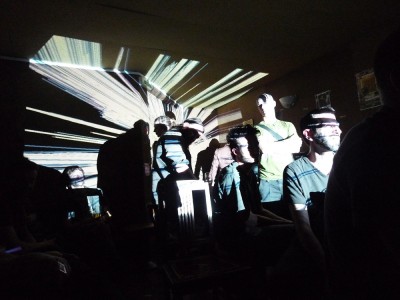
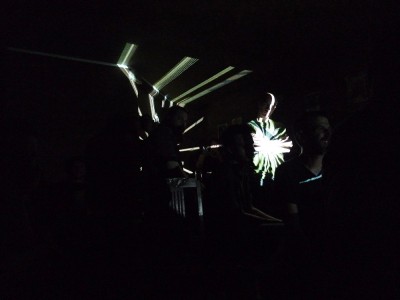
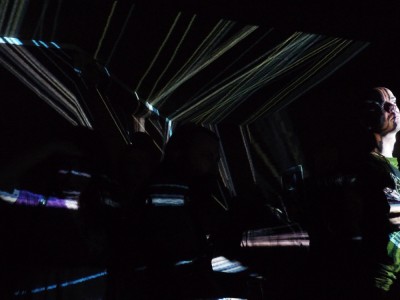
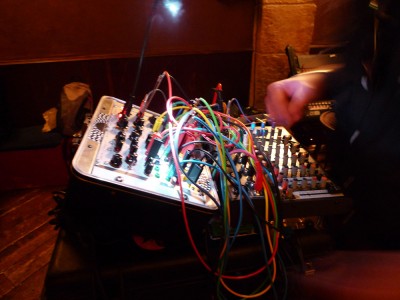
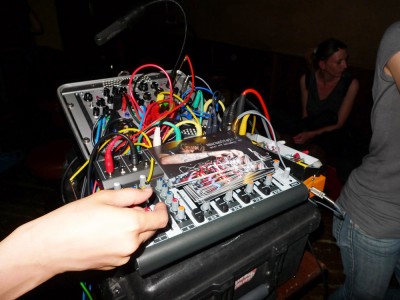
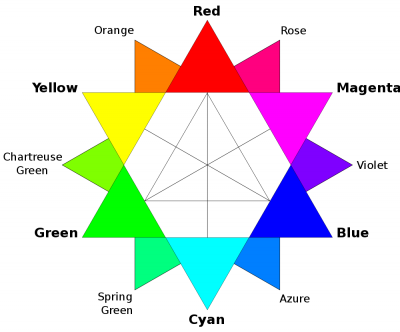
The Chaotic Colorfields performance exploits the psychological intensification which pulsed light adds to the audience’s perception of a sonic event, as well as the physical effect upon the receptors of the eye created by contrasting colorfields. Four colored strobes are directly driven by a self-built analog synthesizer set up to calculate a variety of chaotic feedback systems. Louder than bright and brighter than loud.

Upcoming Performances

EDIT: I’ve decided to postpone this one a bit, to spend more time on making it the best it can possibly be. Upcoming shows in Den Haag, Budapest and Aalborg will be solo improvisations for self-built analog synthesizer without the strobes…

Equipment

* Self-built Analog Modular Synthesizer w/ Light Controller Module
* Stereo or Quadrophonic (preferred) PA System
* Four 1500W or brighter DMX Strobelights, each with one Color Filter (Red, Green, Blue, Yellow/Orange)
* Smoke Machine
* Total Darkness

Background

Chaotic Synthesis

Chaotic systems are deterministic dynamic systems that have a high sensitivity to initial conditions. Only dynamic systems that include a nonlinear feedback path are capable of chaotic behavior. Common examples of chaotic systems include coupled pendulums, pseudorandom number generators, and the earth’s weather system[…] Nonlinearity and feedback are necessary conditions for the existence of chaotic processes.[1]

The Colour Out of Space

The colour, which resembled some of the bands in the meteor’s strange spectrum, was almost impossible to describe; and it was only by analogy that they called it colour at all…

…as the column of unknown colour flared suddenly stronger and began to weave itself into fantastic suggestions of shape which each spectator described differently, there came from poor tethered Hero such a sound as no man before or since ever heard from a horse[…] That was the last of Hero till they buried him next day.[2]

Imaginary Colors

Non-physical, unrealizable, or imaginary colors are points in a color space that correspond to combinations of cone cell responses that cannot be produced by any physical (non-negative) light spectrum.[3] Thus, no object can have an imaginary color, and imaginary colors cannot be seen under normal circumstances. Nevertheless, they are useful as mathematical abstractions for defining color spaces.[4]

Perception of Imaginary Colors

If a saturated green is viewed until the green receptors are fatigued and then a saturated red is viewed, a perception of red more intense than pure spectral red can be experienced. This is due to the fatigue of the green receptors and the resulting lack of their ability to desaturate the perceptual response to the output of the red receptors.[5]

Color as Subjective Experience

In a viewer’s experience, the perceptual interpretation of the context is expressed in the color itself; we usually cannot, or only with unreasonable effort, separate the “real” color from its context. In particular, we are normally completely unaware of the “cognitive” aspects of color perception — discounting the illuminant, spatial perspective, shadows, memory, object concepts, available color labels, and so on.[6]

[1]Slater, Dan, “Chaotic Sound Synthesis”, Computer Music Journal 22.2 19 September 1998, pp 12-19.
[2]Lovecraft, H.P., “The Colour Out of Space“, “Amazing Stories” September 1927.
[3]MacEvoy, Bruce, “Light and the Eye”, http://www.handprint.com/HP/WCL/color1.html
[4]http://en.wikipedia.org/wiki/Imaginary_color
[5]Lindsay, Peter and Norman, Donald, “Human Information Processing,” Academic Press, 1972, pp 196–216.
[6]MacEvoy, Bruce, “Basic Forms of Color”, http://www.handprint.com/HP/WCL/color4a.html
Tags: , , ,

Tiny Noise showcase/TodaysArt, Den Haag 25 September 2010

Posted in Announcement on August 14th, 2010 by admin

Tiny Noise showcase/TodaysArt
subject = LOUDNESS

De Vinger, Bagijnestraat 25
Den Haag 25 September 2010

Andre Goncalvez [PT]
Derek Holzer [USA/DE]
John Fanning/Massaccesi[USA]
Koray Tahiroglu [TU/FI]
Kyd Campbell [CAN/DE]
DJ Toni Dimitrov/Every Kid on Speed[MK]

Looking forward to the chance to do another chaotic synth-controlled strobe piece here. Thanks to Kyd for hooking the whole deal up!

Now Playing

g.i. gurdjieffmeetings with remarkable men book [1963]
starkweatherthis sheltering night[2010 deathwish inc]
throneslate for dinner 7″[2010 conspiracy]

Tags: , , ,

Testing for Chaos

Posted in Announcement on August 9th, 2010 by admin

The following are tests of the chaotic synthesis system I’m working on, and in no way should be considered “finished pieces”:

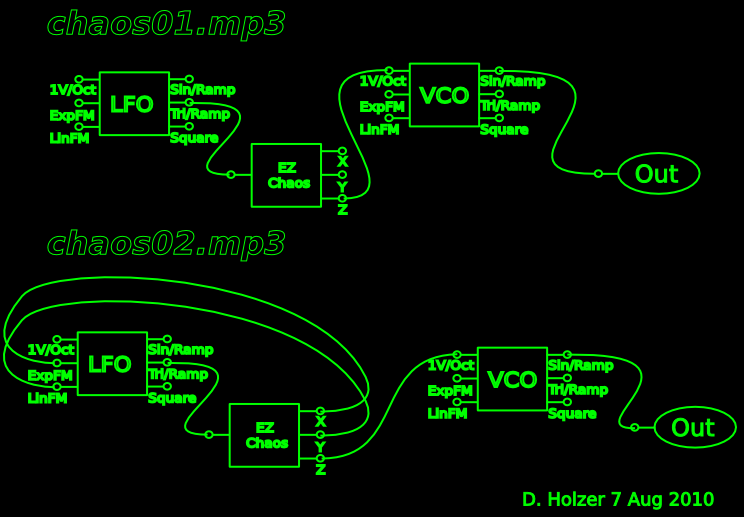
*chaos01.mp3

*chaos02.mp3

Modules used in these recordings:

Thomas Henry XR-2206 VCO (Bugbrand PCB layout)(VCO range)
Thomas Henry XR-2206 VCO (Bugbrand PCB layout)(LFO range)
Ian Fritz EZ Chaos (Uncle Krunkus stripboard layout)

In the first example, chaos01.mp3, the triangle waveform of the LFO drives the EZ Chaos. The Z (marked NL on schematic) output of the EZ Chaos drives the 1V/Oct input of the VCO. Both Drive and Rate pots are set about at the middle, and the Damping is totally turned down. As you can hear, it maintains a very steady modulation. The changes in modulation pattern only come from my manually adjusting the LFO.

In the second example, chaos02.mp3, the poti settings and routing remain the same from chaos01.mp3. However, I have routed the Y output to the Linear FM of the LFO, and the X output to the Exponential FM of the LFO. The modulations become much more chaotic in this setup. Through the clip, I adjust the depth of the LinFM, ExpFM and the general rate of the LFO. Better, don’t you think?

For me, the modulation patterns in chaos01.mp3 sound to me like a non-linear transfer function, but don’t sound chaotic at all in the sense that the transfer function remains almost identical for every cycle of the LFO at any frequency tested.

My understanding of chaotic synthesis usually involves feedback between at least two–but in my experiments up to 8–cross-modulated VCOs with a non-linear function in the feedback loop. The results tend towards certain attractors, but every cycle is distinct from the previous one, even if after 3 or 7 or 15 cycles you might return to a common origin.

Assuming that my EZ Chaos circuit functions as it should, the benefit I see out of it would be the ability to make chaotic patterns from a single LFO through the feedback. Normally I would have to use 2 or more LFOs to get the same kind of chaotic oscillations.

However, by itself I don’t hear chaos coming from this circuit, only non-linearity. It’s the feedback in chaos02.mp3 that makes it chaotic for me. Looking at a double well attractor on the scope is one thing, but hearing it is the proof…

Updated info on the chaos circuit as well as some tuning tips can be found on the Elby Designs page for their ED108-ChaQuO module.

Tags: , ,

UH Fest Budapest 9 Oct 2010

Posted in Announcement on August 9th, 2010 by admin

Just confirmed to play UH Fest on the night of 9 October, sandwiched tightly in between one workshop in Malmö and another in Bergen that I will post about later on. The UH set will be solo for chaotic analog synthesizer, smoke and lights.

So far the confirmed artists for the night are:

Derek Holzer
Lau Nau
Valerio Tricoli with Robert Piotrowicz
Kuupuu
Jazkamer
STU
Thomas Fehlmann

More fun than a poke in the eye!

Now Playing

antoine chessexle point immobile 3″ cd[2010 mnoad]
antoine chessex & valerio tricolichessex/tricoli 12″[2010 dilemma][merci antoine!!!]
bastard noisea culture of monsters cd[2010 deep six]
don hasslerno subsequent interference cd[2010 vicmod]
elu of nineelu of the nine cs[2010 woodsmoke]
jason r. butcherchaotic synthesis recording #3 cd[2009][thx jason!!!]
keith barnardcolour harmonies cs[1985]
neanderthalofficial discography[1990-92]

Tags: , , ,

Analog Multiplier Module

Posted in Documentation on August 3rd, 2010 by admin

Overview

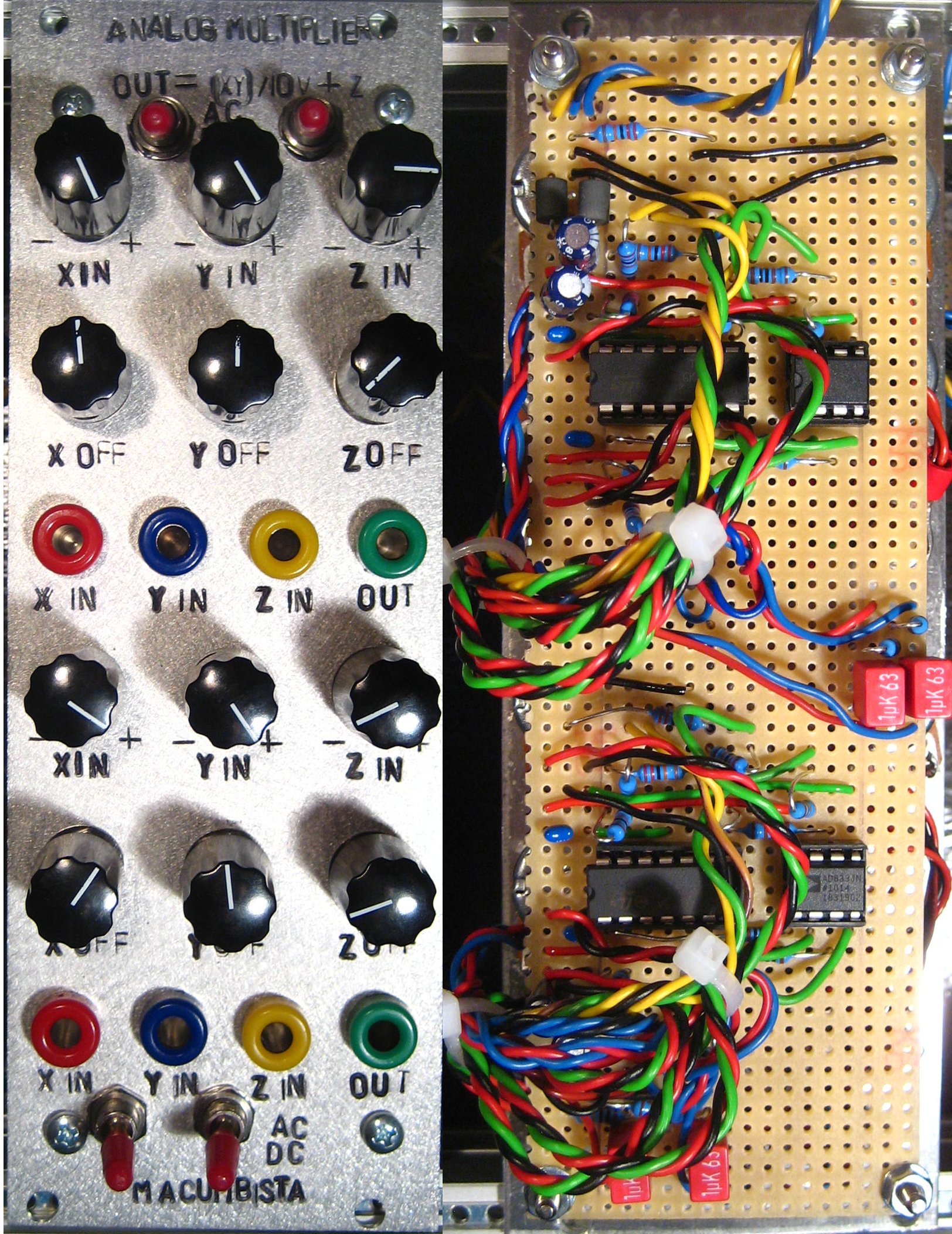
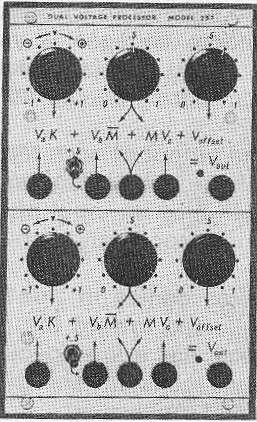
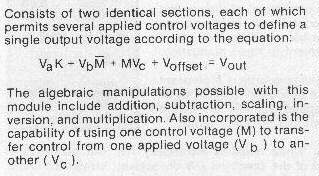
This synthesizer module allows “Buchlidian” style processing of three input voltages. It can do much of what the original Buchla 257 Voltage Processor does: addition, subtraction, multiplication and division. The only feature of the 257 it lacks is the ability to “transfer control” (i.e. interpolate) between the two different applied voltages

It contains one section with three attenuverting/bipolar inputs, which allow the user to sweep between the original signal on the right hand side of the potentiometer and an inverted version of the signal on the left hand side, with no signal passing through at the middle position. An offset control is also present to add a fixed DC voltage to the signal.

The other section contains an analog multiplier with three inputs, X, Y and Z, each hardwired to one of the attenuverting outputs. Output is calculated as follows:

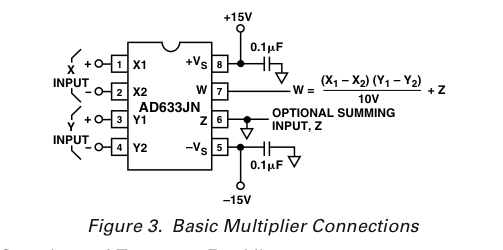
W out = ((X1 – X2)(Y1 – Y2)) / 10V + Z

The panel contains two of each section. The X and Y inputs can be switched between AC and DC coupling, with an AC breakpoint of approximately 0.2 Hz, while the Z input is always DC coupled.

Schematic

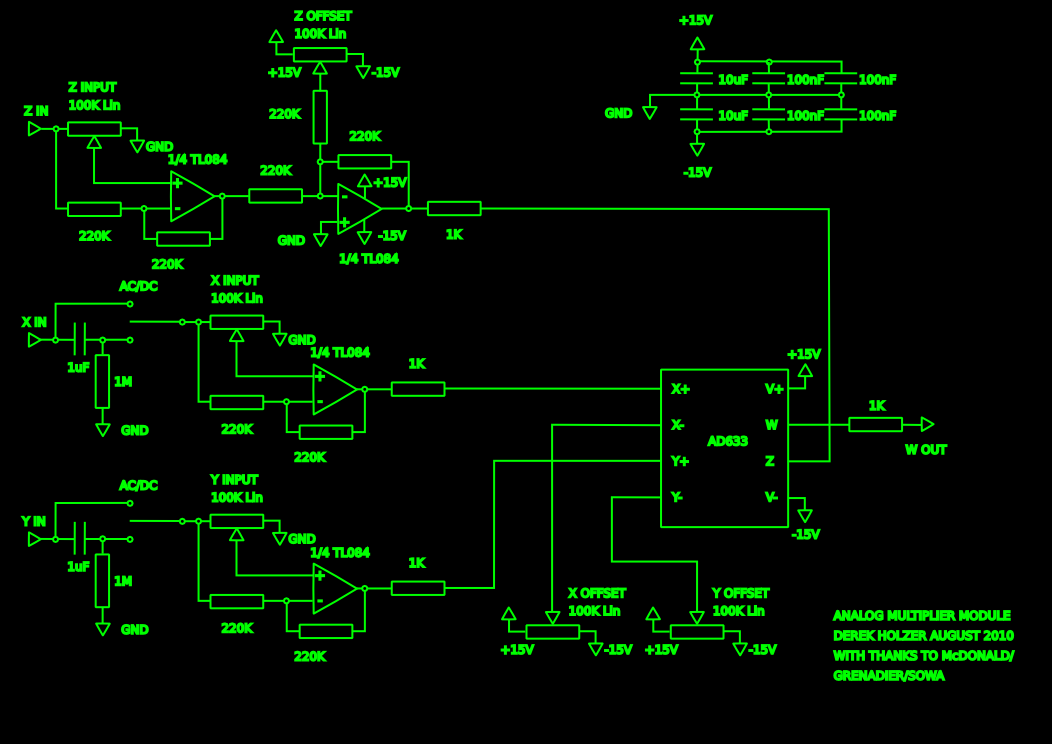
Tom Bugs described himself as a magpie to me once in regards to his circuit designs, and while working on this module I have followed his lead. The “attenuverter” sections were designed by Chris MacDonald and modified by Peter Grenader, and have been further developed by Matthias Herrmann/Fonitronik.

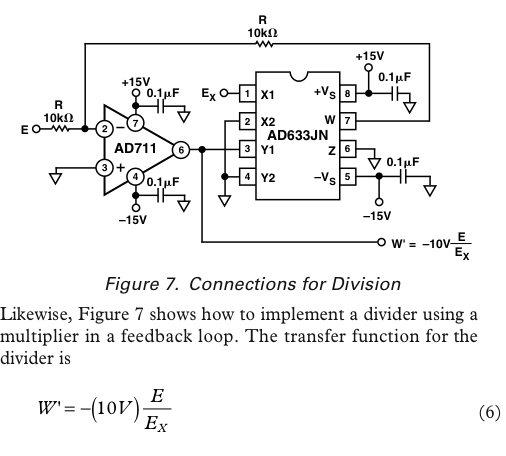
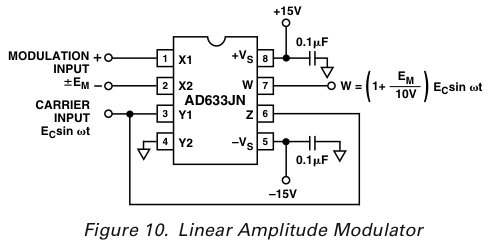
Likewise the analog multiplier section is really just bringing every feature of the AD633 4 quadrant multiplier chip to the front panel, with some inspiration from Roman Sowa’s Ring Modulator design, as well as Marc Bareille’s adaption of that same design.

[click schematic to enlarge]

Usage

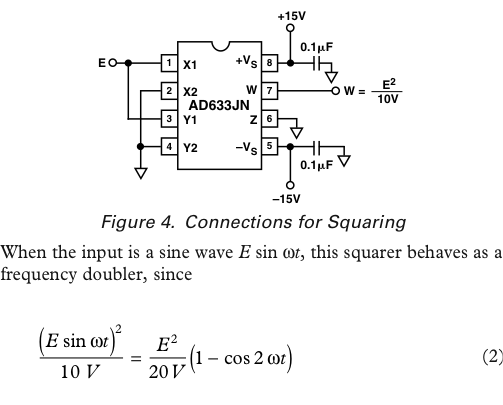
The AD633 documentation shows different applications such as simple multiplication, squaring and division as well as more complex tasks such as a linear Voltage Controlled Amplifier as well as 6dB/Octave Voltage Controlled Filters and a Quadrature Oscillator (both not shown here). The most common sonic use of this IC is for ring modulator circuits.

However, my main application for this is the creation of different kinds of transfer functions for use in chaotic synthesis. I discovered how useful the analog multiplier is while experimenting with the Doepfer system at KHM in Cologne. Multiplying two oscillators through a ring modulator, sending the result to modulate the first oscillator and using the first to modulate the second created an amazing array of unpredictable but certainly far from random results.

In most applications shown in the datasheet, the X and Y offset pins are grounded. But while breadboarding, I discovered that the X and Y offset gave a higher level of control over the modulations, so I built them into the panel. Likewise, switching between AC and DC coupling alters the resulting sound immensely, with the best results coming from one signal being AC coupled and one being DC coupled.

Adding one of the X or Y input signals to the Z input creates a kind of VCA which strengthens the effect. Or using another signal, such as a Low Frequency Oscillator with some suitable gain and offset, adds another modulation source into the mix to provide anything from amplitude modulation to clipping.

I believe this module gets at just about any type of processing the AD633 can do, as most of the time there is no attenuation, inversion, Z input or any kind of offset available on a normal ring modulator or analog multiplier.

Sample Applications from the AD633 Datasheet

Tags: , ,

Prototyping/Analog Computer Modules

Posted in Documentation on July 30th, 2010 by admin

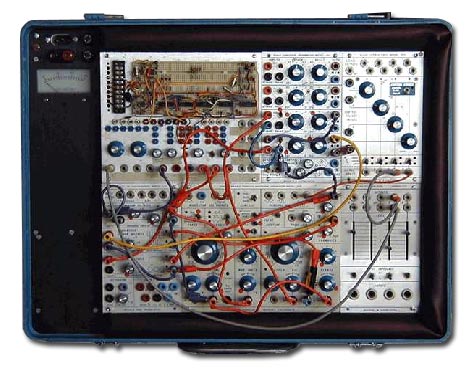
I’ve been having some great correspondence with Jason R. Butcher about Buchla synthesizers, analog computers and chaotic synthesis techniques. He reminded me of a very special version of the Buchla 200 Music Box, created by Don Buchla for an electronics and cello work by Ami Radunskaya called Sili-Con Cello in about 1978 or 1979.

One of its features was a breadboard prototyping module, seen in the upper left corner. Here, Buchla created custom circuits to respond to the performance gestures of acoustic instruments in the era before Pure Data or Max/MSP.

[Photo from The Audities Foundation]

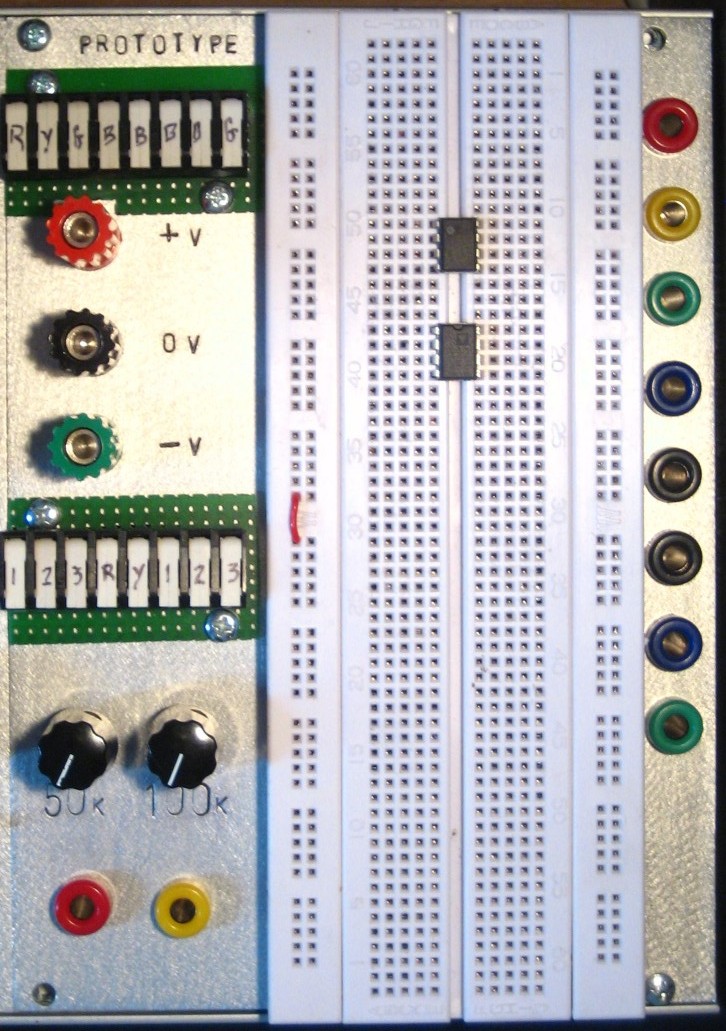
Jason showed me his own version of the breadboard module, which just happened to look a lot like a panel I spec’ed out last night. Here’s the completed module mounted in the case this afternoon. Each panel component (potentiometers and banana jacks) is routed to the terminals (the green areas), which in turn can be jumpered anywhere on the breadboard.

My first task with this module will be to design a “Buchlidian” style control voltage processor. It will contain one section with an attenuverting/bipolar input with offset and another section with an analog multiplier. The panel will have two of each section. It can do much of what the original Buchla 257 Voltage Processor does: addition, subtraction, multiplication, division…

The only thing it won’t be able to do is the “transfer control” (i.e. interpolate) between the two different applied voltages (although this could probably be done with a pair of Voltage Controlled Amplifiers rigged up as a cross-fader).

This new processor module represents one section of a larger analog computer project I plan to use for developing new chaotic synthesis techniques. The other sections would be a set of integrators (planned), an analog logic section (completed) and a suite of tools for working with digital pulses (comparators, clock dividers, digital logic and digital noise–all planned).

Of course, this prototyping module could also be used to lay out other kinds of non-linearizing functions to stick in the chaotic feedback paths. I’ll document those as they come up.

Discussions over the last year or so with Martin Howse continue to remind me that analog computers evolved out of the V2 rocket program and were mainly designed to control the flight path of missiles. In fact, just about anything used in electronic music has some sort of seedy military past. Our art is nothing more than a byproduct of the quest to more accurately drop bombs on each other, something I’m sure both Stockhausen and Kraftwerk were acutely aware of…

As for Mr. Butcher, check out his wild, live analog synthesizer project with Don Hassler. Buchla 200 Music Box vs EMS Synthi A, highly recommended!

Hassler/Butcher, Eyedrum, Atlanta 31.03.10

Tags: , ,

New synth modules, July 2010

Posted in Documentation on July 28th, 2010 by admin

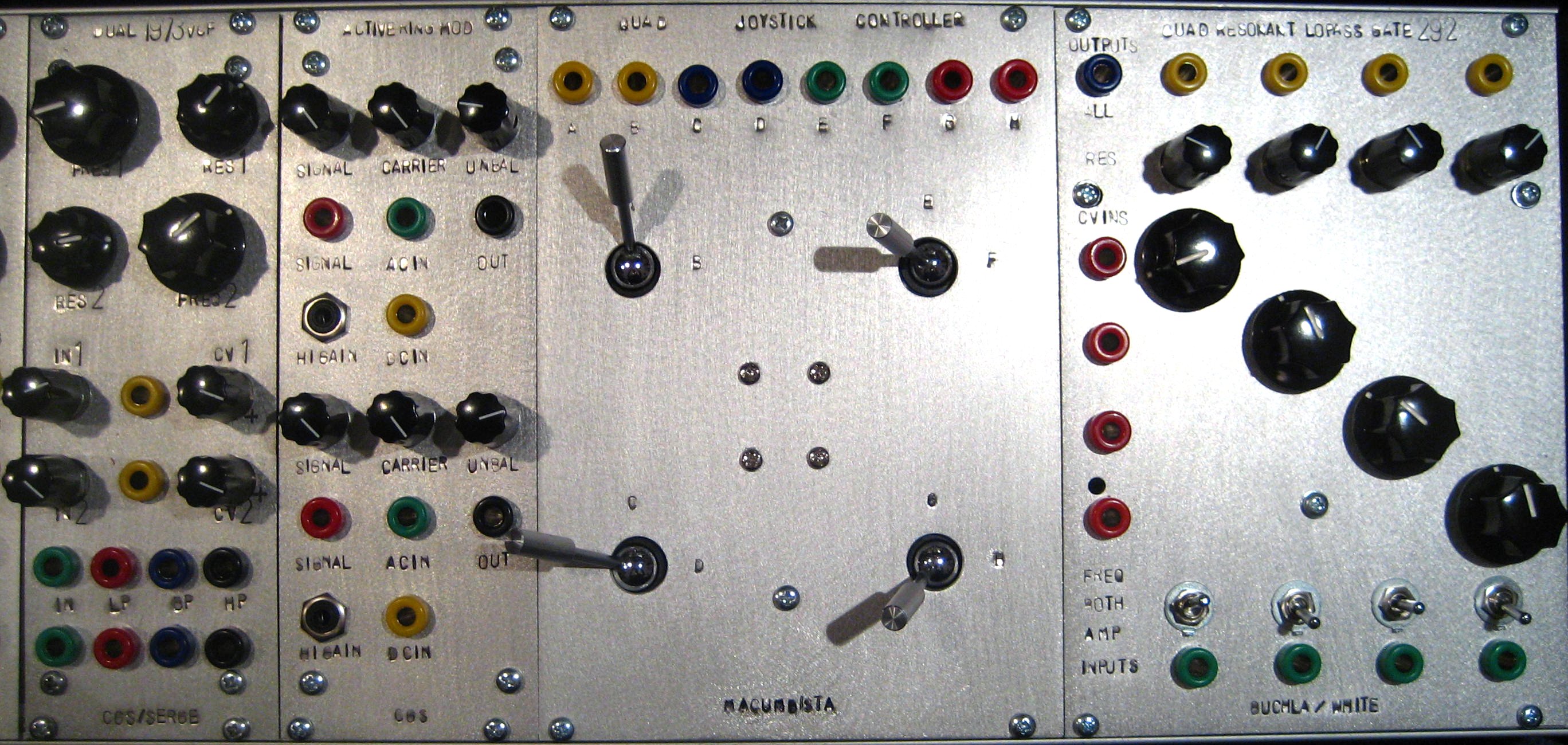
Hot off the bench! Click to enlarge!

Dual Serge 1973 Voltage Controlled Filter (CGS)
Dual Active Real Ring Modulator (CGS)
Quad Joystick Controller (Macumbista)
Quad Resonant Lopass Gate 292 (Buchla/T. White)

Think I’m gonna build me a little analog computer next, something like this one. All this stuff should get put to good, chaotic feedbacking use for my ISEA Dortmund performance in a few weeks.

Now Playing

whitehousegreat white death special edition cd[1984/1997 susan lawly][iiiiiiiiii’mmm cooooommmiiiiiiiiiinnnnnggg…]

Tags: , ,

Mal Au Pixel photos

Posted in Documentation on July 28th, 2010 by admin

On 25 June, 2010, I played a live synthesizer improvisation in the hot, airless basement of Le Chat Noir, Paris. Accompanying me on this journey through the depths was Andreas Siagian (House of Natural Fiber, Jogjakarta), who made amazing video projections directly onto the audience from his position just behind me. Thanks to Mal Au Pixel for a fantastic time in Paris!!!!!!

All photos by Sylvie Astié (Dokidoki) except the last one of me and organizer Kevin Bartoli standing over my “busker’s suitcase” by Mathieu Margueri (Mal Au Pixel). You can see more Mal Au Pixel photos on their Flickr pageMathieu Margueri’s Picasa and Nathalie Aubry’s Flickr. You can also read Nathalie’s report on the festival for Pixelache.

Now Playing

belts/he cs[1991]
black mountain transmitterblack goat of the woods[2009 lysergic earwax]
merzbowrainbow electronics[1990 alchemy]
peter yatesbullitt film[1968]
sam peckinpahthe getaway film[1972]
sam peckinpahthe wild bunch film[1969]
toshio matsumotoexperimental film works[1961-87 ubu.com]

Tags: , , , ,

Neanderthal Electronics Aalborg, DK 20-23 October 2010

Posted in Announcement on July 20th, 2010 by admin

We are happy to announce the first confirmed artist for APPARAT.

Those in love with the art of sounds (and noise ! ) can already count the days until Derek Holzer (US) arrives to Aalborg. HIs main profile is precisely the studies of noise and its art-tech application. Holzer will run a four-days long workshop under the title Neanderthal Electronics where the participants will construct their own personal analog synthesizers and in the end they will collaborate in a public performance. During this workshop both simple-primitive/found objects and modern devices (capacitors, transistors, LEDs, sensors and different audio inputs etc) will be applied in order to achieving the perfect and very personal sound environment.

Beside leading the noise-workshop Holzer will perform himself as well. A solo and improvised performance will be presented by him and a bunch of analog sound equipment.

Please note that pre-registering is required for the workshop. More info on this to come.

Now Playing

bee maskcanzoni dal laboratorio del silenzio cosmico cs[2010 gift tapes]
expo 70the vanishing world within[2010 sonic meditations]
fred nipiqanngirpalippuq lp[2009 galerie pache](merci fred!!!)
john faheyfare forward voyagers (soldier’s choice)[1973 takoma]
lars lundehave hansencatching fire[2010 con-v]
mika vainio & kouhei matsunaga-split lp[2010 important]
tomoko sauvage + noyadeasper #1 winter 09 split lp[2009 asper](arigato tomoko-chan!!!)
various artiststo scratch your heart: early recordings from istanbul[2010 honest jons]
zaïmphcoast to coast c40[2010 gift tapes]

Tags: , , , ,

Formanta Drone [surface noise]

Posted in Documentation on June 25th, 2010 by admin

Formanta Drone [surface noise] by macumbista

An older track from 2003, but one that I still appreciate. It uses the sample-and-hold noise-driven LFO of a Soviet-era Formanta EMS-01 synthesizer, digitally cross-bred with the surface noise at the end of a scratchy old Russian vinyl. Reflecting on this piece, I can see the start of a deep interest in automatic, generative and self-modulating processes taking shape. Thanks to Maksim Borisov for use of his amazing electronic museum piece! Originally released as part of the Karosta Project.

Tags: ,